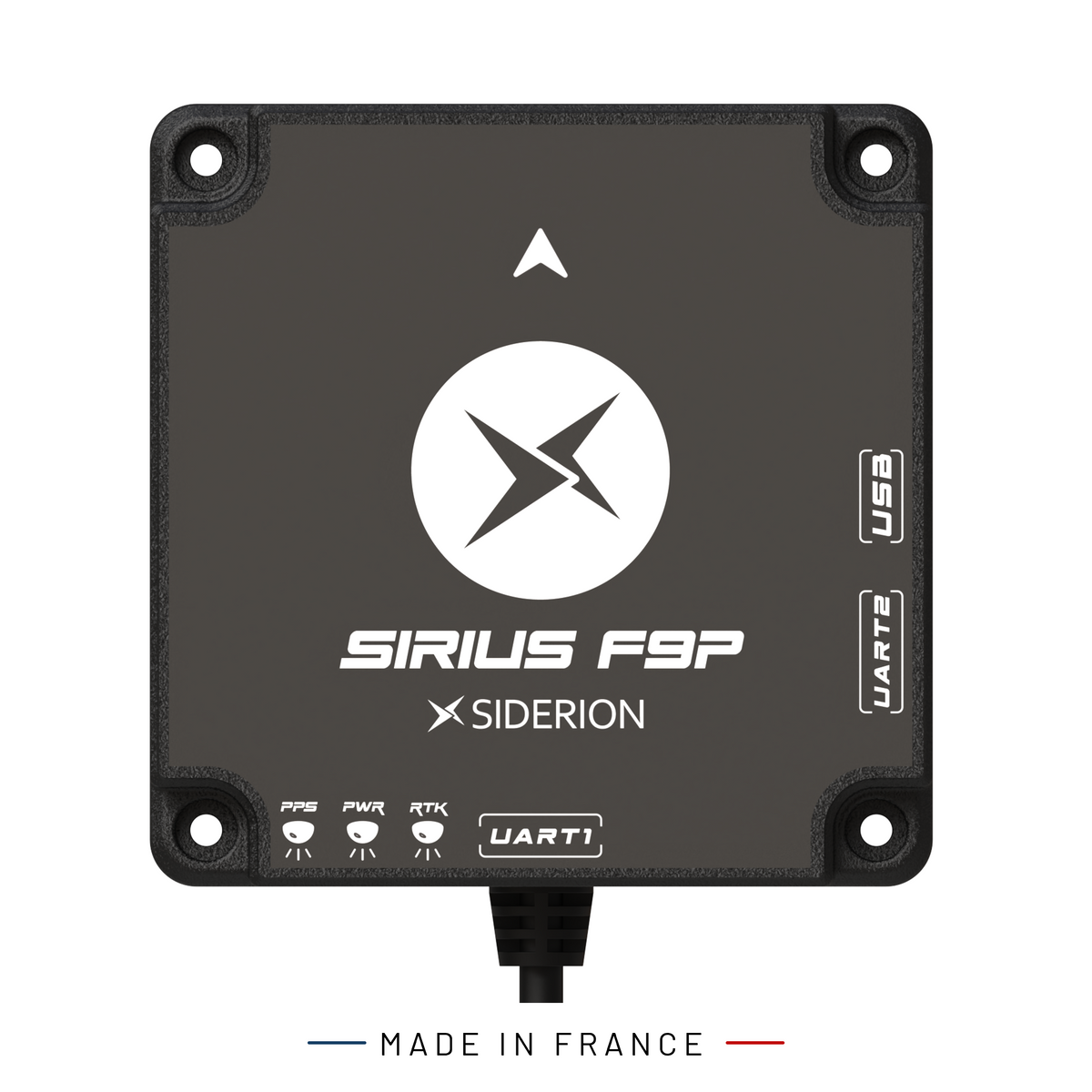
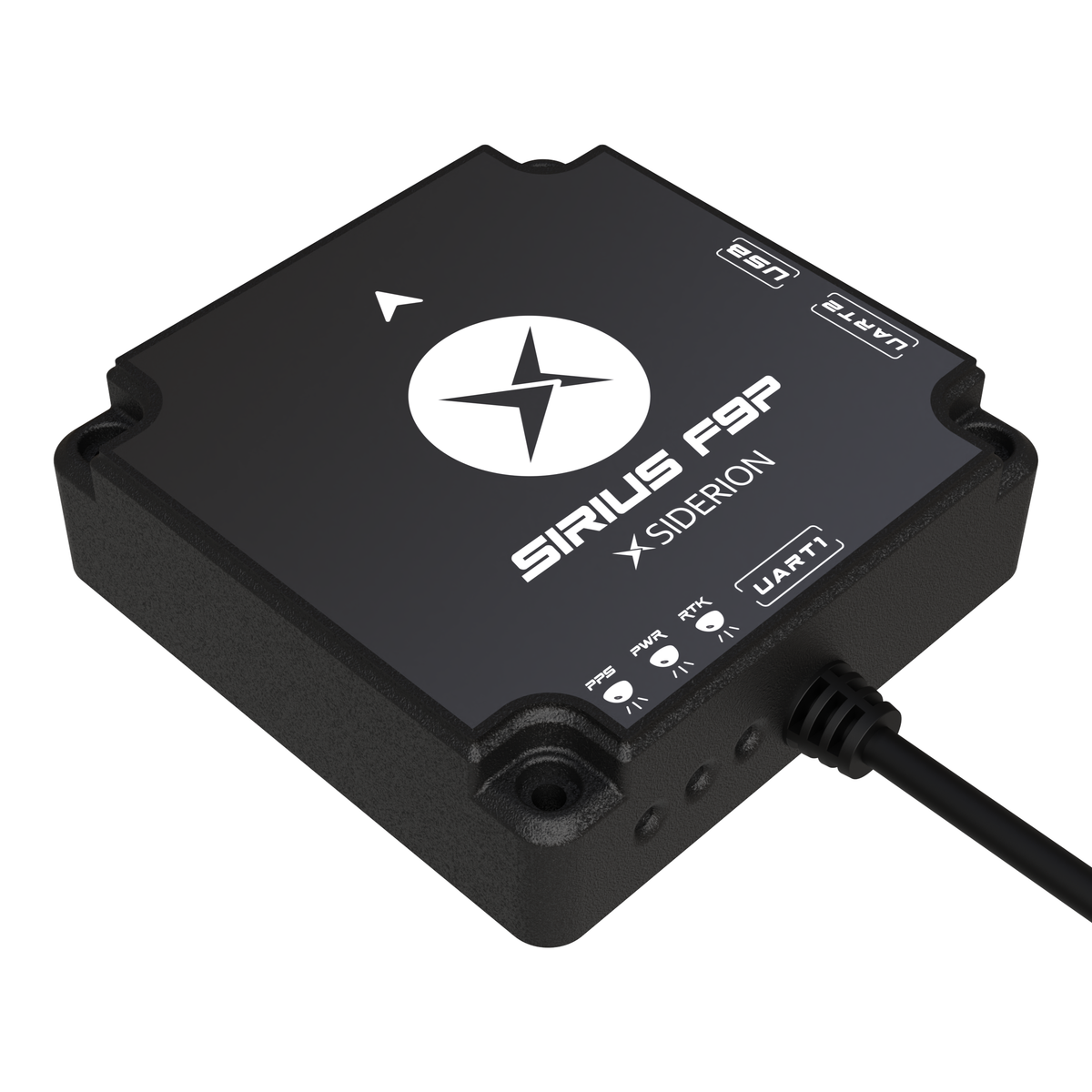
Out-of-the-box RTK GNSS receiver paired with an onboard active patch antenna and high-precision magnetometer.
Achieve centimeter-level accuracy with the best-selling Sirius F9P rover (since 2019). An all-in-one, dual-band L1/L2 RTK GNSS device based on the u-blox ZED-F9P.
➤ RM3100 professional-grade magnetometer. ➤ Built-in high-gain L1/L2 active antenna. ➤ Built-in 6P JST-GH chord for immediate compatibility with any flight controllers. ➤ USB-C & JST-GH interfaces. ➤ Compatible with Pixhawk, ArduPilot and Betaflight.
Ideal for UAVs, fixed-wings, robotics, and precision farming.
What positioning accuracy does the Sirius F9P achieve? When operated in RTK mode with active corrections, the SiriusF9P delivers centimeter-level precision (1 cm horizontal, 2 cm vertical) within seconds.
Does the Sirius F9P have an onboard antenna? Yes, the Sirius F9P is equipped with an embedded L1/L2 high-gain active patch antenna. No additional GNSS antenna is required.
Can the Sirius F9P be used as both a Base and a Rover?
Yes. The module supports flexible roles and can function as a mobile rover receiving RTK corrections, or as a stationary base station broadcasting correction data.
How can I access the RM3100 magnetic sensor data? The data from the RM3100 magnetic sensor is available through the I2C port. Compatible autopilots can retrieve this data to compute the heading.
How do I connect the Sirius F9P to my autopilot or flight controller? It provides plug-and-play integration using standard 6-pin JST-GH connectors via UART or I2C, fully compatible with Pixhawk, ArduPilot and Betaflight platforms.
How do I configure and update the module settings? You can easily configure parameters, monitor satellite signals, or log raw data by connecting the onboard USB-C port to a PC running u-blox u-center or u-center 2 software ➜ u-center | u-blox
Sirius F9P overview
Thanks to the Sirius F9P, enjoy centimeter-level precision, fast convergence times and high update rate for highly dynamic applications. Its on-board active antenna minimizes the time to action for a seamless experience for all your precision projects.
Get all major constellations reception (GPS, GLONASS, Galileo , BeiDou, plus QZSS reception) owing to its multi-band RF front-end architecture.
➤ Increases precision performance in difficult environments by leveraging a greater diversity of GNSS signals.
➤ Supports a variety of modern correction service technologies (RTCM v 3.x, SSR, PPP).
➤ Integrates advanced jamming and spoofing detection to achieve highest levels of security.
The Sirius F9P supports 184 channels for concurrent multi-constellation tracking.
Centimeter-Level Accuracy
Achieves 10mm (1cm) precision with multi-band RTK GNSS.
Dual-Band L1/L2 Technology
Reduces ionospheric interference, ensuring faster convergence and superior accuracy compared to single-band GNSS receivers.
RM3100 Mag Sensor Professional-grade magnetometer that considerably improves heading performance. High-sensitivity, High noise immunity, low power.
Fast Convergence Sub-10-second RTK convergence for rapid, reliable positioning.
Versatile Correction Support Compatible with RTCM, VRS, and Network RTK for flexible, high-accuracy positioning.
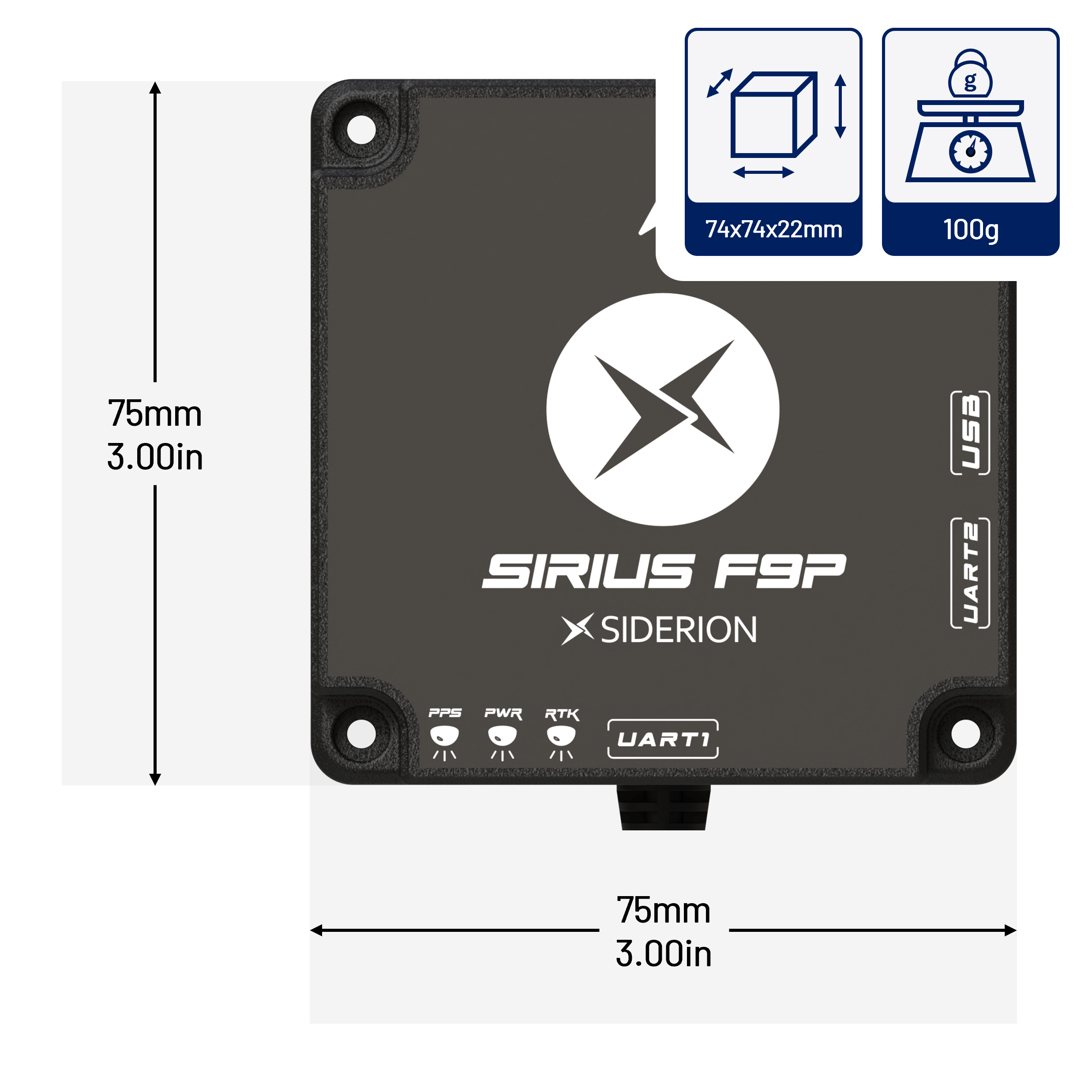
Compact & Energy-Efficient Perfect for OEM integration and low-voltage applications.
Base or Rover Operation Use as a standalone receiver or in a base-rover RTK configuration.
Anti-Jamming & Spoofing Protection Advanced interference suppression for secure operation in challenging environments.
Plug-and-Play Compatibility Seamlessly integrates with any autopilots via a 6-pin JST-GH connector, with support for UART, I2C, USB, and MAVLink protocols.
Fast & Reliable Up to 20 Hz update rate for real-time responsiveness in dynamic applications.